
From this article, you will learn:
- What are the types and dimensions of pallets? What should their proper arrangement look like?
- How many pallets fit on a standard "lorry"?
- How to load 33 pallets onto a standard trailer?
- How many empty 120x80 pallets can fit on a standard trailer?
- How to arrange 120x120 pallets and how many can be loaded?
- How many pallets fit on a standard lorry and how many on a set?
- How to calculate the load capacity coefficient, trailer fill coefficient (surface), and trailer load capacity of a lorry?
- How to quickly calculate how many pallets will fit on a "lorry"?
- Who is responsible for the correct arrangement of pallets on a trailer?
- Summary – the most important rules for arranging cargo on a trailer.
Types and dimensions of pallets and their correct arrangement
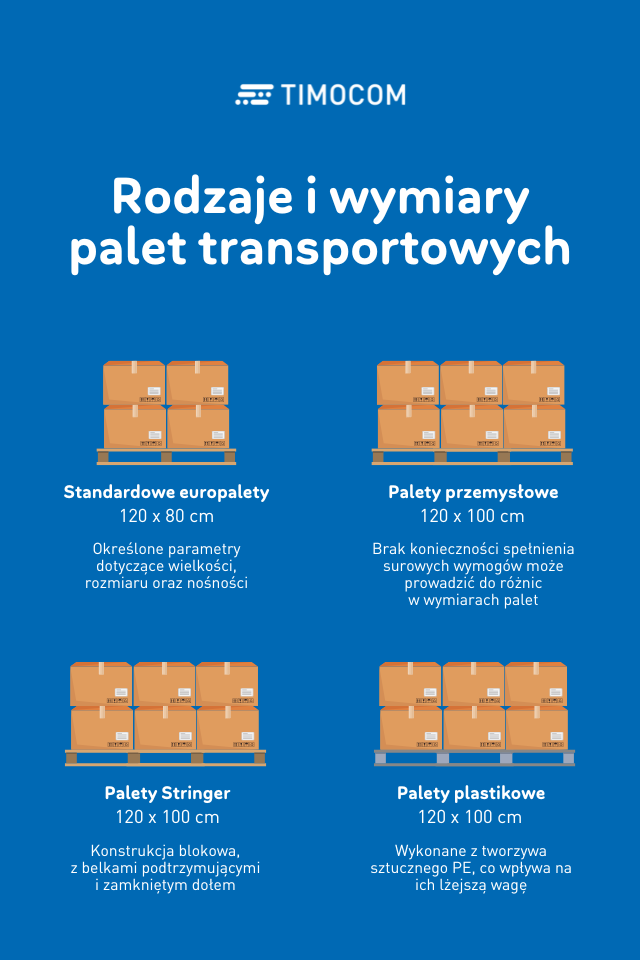
The proper arrangement of pallets on a trailer depends on several factors, including the type and dimensions of the pallets. Standard Euro pallets are commonly used in Europe and have dimensions of 120 x 80 cm. Industrial pallets are slightly larger than Euro pallets (their dimensions are 120 x 100 cm), which allows for more goods to be placed on a single pallet, translating into more efficient use of warehouse space and lower transport costs. There are many other types of pallets, such as plastic pallets and stringer pallets, which are lighter and easier to load onto various means of transport. For example, plastic pallets are made of PE plastic, which results in a lower load weight, while stringer pallets have a specific structure reinforced with supporting beams, called "stringers". Despite their construction, plastic pallets and stringer pallets have the same dimensions as industrial pallets, and their number on a trailer should not exceed 33 on the floor and 66 in the case of stacking.
So, if you are wondering how many Euro pallets or industrial pallets fit on a trailer, you must consider not only their dimensions but also the number of pallets.
Goods on the trailer – optimal arrangement of pallets
How many pallets fit on a "lorry"? A standard trailer with a length of 13.6 meters can accommodate up to 33 Euro pallets (120 x 80 cm), arranged in three rows of 11 pallets each. When it comes to industrial pallets, which are slightly longer (1200 x 1000 mm), their number on a standard lorry trailer with dimensions of 13.6 x 2.24 x 2.7 m cannot exceed 26 pieces Of course, the number of pallets can vary depending on the type of trailer, specifications, and type of goods – more pallets fit on trailers with a double-deck system It is also important how many cubic meters the "lorry" trailer has and what load space is available.
How to load 33 pallets onto a standard trailer?
To load 33 Euro pallets onto a standard "lorry" trailer, you should use a layout where the pallets are arranged in 11 rows of 3 pallets each in width. This arrangement ensures maximum use of the loading space. It is important that the pallets are placed tightly, without unnecessary gaps, which will minimize the risk of the load shifting. Transporting pallets is not everything – you must also remember to properly secure the load with lashing straps.
How many empty Euro pallets fit on a trailer?
On a standard trailer (13.6 meters long), you can load approximately 500 empty Euro pallets (120x80 cm). The pallets are arranged in high stacks, allowing for maximum use of vertical space.
How many pallets fit on a "lorry"?
When arranging industrial pallets on a "lorry" trailer, several factors must be considered, including the type of trailer and the method of arranging the pallets.
Considering that the trailer dimensions are 13.6 x 2.45 x 2.7 m, on the floor surface we can arrange:
- Trailer width: 245 cm / 120 cm = 2 pallets in one row.
- Trailer length: 13.6 m (1360 cm) / 100 cm = 13 pallets in one row.
This means that on the floor of the trailerof a lorry with standard dimensions, 26 industrial pallets can fit.
If the pallets are stacked one on top of the other, assuming that the height of the pallets with goods allows it, up to 52 pallets can fit on a "lorry" trailer (26 pallets on the floor and 26 pallets on top).
How many pallets fit on a?
Pallets with dimensions of 120x120 cm are larger than standard Euro pallets, so only 26 such pallets can be loaded onto a standard trailer. These pallets are arranged in two rows of 13 pallets each in width, ensuring maximum use of space.
How many pallets fit on a standard lorry and how many on a set?
A standard trailer can accommodate 33 Euro pallets (120x80 cm). This arrangement results from the size of the loading space, which allows for placing pallets in three rows of 11 pallets each.
A set, i.e., a vehicle with a trailer and a semi-trailer, can accommodate more pallets than a standard trailer. A set can be loaded with approximately 30-40 Euro pallets, depending on the vehicle specifications.
Looking for loads or transport surfaces? On the TIMOCOM Transport Exchange, you will find loads for various types of trailers.
Arrangement of pallets in a van up to 3.5 tonnes load capacity
Arranging Euro pallets (120x80 cm) and industrial pallets (120x100 cm) in a van up to 3.5 tonnes requires optimizing space, as the cargo area dimensions are limited. Typical vans with a permissible total weight (PTW) of up to 3.5 tonnes have various cargo area dimensions, but the most popular ones are 3.2-4.5 m in length, 1.8 m in width, and 1.7-2.2 m in height.
How many pallets fit in a van?
- Euro pallets (120 x 80 cm): in a van 3.2 m long, you can fit 2 pallets, and in a van 4.5 m long, you can fit 3 Euro pallets in one row. Stacking can double the number of pallets.
- Industrial pallets (120 x 100 cm): in a van 3.2 m long, you can fit 2 industrial pallets, and in a van 4.5 m long, you can fit 3 industrial pallets.
- Combining Euro and industrial pallets: you must arrange them along the van, one after the other, as the difference in width does not allow them to be placed side by side.
How to calculate the load capacity coefficient?
The load capacity coefficient can be calculated by dividing the volume of the load by the volume of the loading space. The result obtained is expressed as a percentage and shows how efficiently the trailer space has been utilized. A high coefficient means that the space has been well utilized.
What is the load capacity indicator?
The load capacity indicator is the ratio of the actual mass of the load to the maximum permissible load capacity of the vehicle. This is an important parameter that ensures the vehicle is not overloaded, which could negatively affect transport safety and fuel consumption.
How to calculate the surface utilization coefficient?
The surface utilization coefficient determines how well the loading surface of the trailer is utilized. It can be calculated by dividing the area occupied by the load by the total loading space of the vehicle.
How to calculate the trailer load capacity?
The load capacity of a trailer is the maximum mass of the load that can be loaded onto the vehicle. To calculate how many pallets fit on a trailer, you need to know the permissible total weight of the vehicle and the trailer's own weight.
Trailer load capacity calculator – how to calculate how many pallets fit on a "lorry"?How to quickly calculate how many pallets will fit on a "lorry"?
To accurately calculate how many pallets will fit on a lorry, you can use an online loading calculator. Just enter the dimensions of the pallets and the trailer, and the calculator will automatically calculate the maximum number of pallets that can be loaded.
Who is responsible for the arrangement of the load on the trailer?
The responsibility for the correct arrangement of the load on the trailer lies primarily with the sender of the goods, who should prepare the load in accordance with transport regulations. The driver also has an obligation to check whether the load is correctly arranged and secured. In case of irregularities, the driver should refuse to start transporting the goods, as in the event of a road inspection, they will be responsible for exceeding the norms regarding weight and safety.
Arrangement of pallets on a trailer – key tips
- Even distribution of pallets – avoid overloading one side of the trailer and distribute the goods considering the vehicle's loading space. Pallets should be evenly distributed over the entire surface of the trailer to prevent the goods from shifting during the journey.
- Securing the load – use lashing straps, corner protectors, and anti-slip mats. It is worth considering additional load securing, e.g., wrapping the pallets with stretch film, which will protect the goods placed on the trailer from moisture, dust, odors, etc.
- Avoiding excessive gaps – reduce empty spaces and place the pallets so that they are tightly next to each other. Gaps could cause the load to shift and affect the safety of the entire transport.
- Proper weight distribution – place heavier pallets closer to the center of the trailer and lighter ones at the ends, which affects the better distribution of forces acting on the vehicle. It is important not to exceed the permissible total weight of the vehicle.
- Additional securities and equipment – consider the need to use additional securities and equipment. Some types of pallets require the use of a hand pallet truck, reach truck, pallet truck with extended support arms, or a counterbalance truck, as in the case of a bearer pallet.
Summary
The above rules are an important element in planning the loading, securing the load, and other activities aimed at the safe transport of goods. Maximum optimal use of the trailer space, taking into account the types of pallets, their dimensions and quantities, and the different materials they are made of, affects the cost-effectiveness of goods transport.